Sign In






 Last checked at
Today 07:00
Montanaro UK Smaller Companies Investment Trust PLC
213800UDDXXTXIF29P85
Final Results
2026 Annual Results and notice of annual general meeting
Montanaro UK Smaller Companies Investment Trust PLC (or the 'Company' or "MUSCIT") announces its annual results for the year ended 31 March 2026 and the publication of its annual report and accounts for the same period, which includes the notice of its 2026 annual general meeting.
Highlights
for the year ended 31 March 2026
Performance
Total Returns | 1 year | 3 year | 5 year | 10 year | Since launch |
Share Price1 | 3.0% | 5.0% | (17.3%) | 55.0% | 883.4% |
Net Asset Value ("NAV") per share 1 | 0.1% | 1.0% | (15.7%) | 27.4% | 810.5% |
Benchmark2 | 11.9% | 24.8% | 13.7% | 72.2% | 650.7% |
Benchmark (including AIM)3 | 11.0% | 13.9% | (3.4%) | 58.3% | 789.6% |
Sources: Deutsche Numis, Bloomberg, Association of Investment Companies ("AIC"), Montanaro Asset Management Limited ("MAM").
As at 31 March | 2026 | 2025 | % Change |
Ordinary share price | 93.70p | 97.00p | (3.4) |
NAV per Ordinary share1 | 99.90p | 105.86p | (5.6) |
Discount to NAV1 | 6.2% | 8.4% | |
Gross assets1 | £124.6m | £163.3m | (23.7) |
Net assets | £114.6m | £150.8m | (24.0) |
Market Capitalisation | £107.4m | £138.2m | (22.3) |
Net gearing employed1 | 3.3% | 5.2% |
Year ended 31 March | 2026 | 2025 | % Change |
Revenue return per Ordinary share | 3.2p | 3.3p | (3.0) |
Dividends per Ordinary share | 6.5p | 5.4p | 20.6 |
Ongoing charges1 | 1.0% | 0.9% | |
Portfolio turnover1 | 60.2% | 45.6% |
1 Details provided in Alternative Performance Measures on pages 77 and 78 of the Annual Report.
2 The Benchmark is a composite index with the NSCI used since 1 April 2013 and a different small cap index used from launch to 1 April 2013.
3 This represents the Benchmark with the NSCI including AIM used since 1 April 2013.
4 All data shown is from the date of the Company's launch on 16 March 1995.
How to Invest
The Board has dedicated a great deal of time to make MUSCIT readily available to all investors. MUSCIT has continued to grow its presence across the UK's investment platforms. We are delighted to see a steady increase in MUSCIT's retail following.
For further details about how to invest, please refer to the website: https://montanaro.co.uk/trust/montanaro-uk-smaller-companies-investment-trust/
Chairman's Statement
I am pleased to present the thirty-first annual report of MUSCIT for the year ended 31 March 2026.
In the year to 31 March 2026, the Net Asset Value ("NAV") of MUSCIT returned 0.1%. In comparison, the Numis Smaller Companies (excluding investment companies) Index (the "NSCI") gained 11.9% and the NSCI including AIM increased by 11.0%. During the same period, the share price of MUSCIT increased by 3.0% as the discount narrowed from 8.4% to 6.2%.
Results
Despite the disappointing short-term performance, discussed in the Manager's report below, since launch in 1995 the Company has delivered a cumulative NAV total return of 811%, significantly outperforming the composite benchmark return of 651%.
Dividends
The Board believes the Company's dividend policy plays a key role in attracting new investors and rewarding existing investors, helping to narrow the discount. In December 2024, the quarterly dividend was increased from 1% to 1.5% of the Company's NAV, equivalent to an annual NAV yield of approximately 6%. Based on the current discount of 6.2%, this implies a share price yield of 6.4%.
Quarterly dividends are calculated on the last business day of the preceding financial quarter, being the end of March, June, September and December.
During the financial year, the Company paid four quarterly dividends amounting to a total of 6.51p, equivalent to 6.7% of the share price at the start of the year and 6.9% of the share price at the end of the period. This was higher than all other UK SmallCap trusts (source: Deutsche Numis).
The Company holds substantial reserves which are available for continuing to pay attractive dividends in future.
Costs
The Board remains highly focused on reviewing and managing costs. Effective from 31 December 2024, the investment management fee of 0.50% per annum is now calculated based on net assets rather than gross assets. The fee remains one of the most competitive within the UK SmallCap investment trust sector.
The Company's ongoing charges have marginally increased to 1.0%, following a decrease in net assets during the financial year following substantial share buybacks.
Share Buybacks
The Board is responsible for share buybacks which are undertaken at arm's length from the Manager. These are regularly considered by the Board and implemented when considered to be in the best interests of shareholders.
In February 2025, the Board confirmed its commitment to an active share buyback policy, with the view to maintaining the discount in single digits in normal market conditions. The share buyback authority was renewed at a General Meeting held on 20 May 2026.
During the Financial Year, the Company bought back 27,736,173 shares representing 19.5% of outstanding shares, which are held in treasury.
Discount
Over the last financial year, the discount of MUSCIT's share price to NAV narrowed from 8.4% to 6.2%.
The Board and the Manager have worked hard to make MUSCIT attractive to private clients, including: a five-for-one share split in 2018; twice enhancing its dividend policy; reducing costs; and increasing the focus on marketing. These initiatives are bearing fruit, with a growing number of retail investors now appearing on the share register.
Gearing
The Board, in consultation with the Manager, regularly reviews the gearing strategy of the Company and approves the arrangement of any gearing facility. The ability to issue debt to gear the portfolio is a key feature of investment trusts that we believe offers a strong competitive advantage over open‑ended investment funds. Gearing can enhance investment returns to shareholders. The Board strongly encourages active use of the gearing facility by the Manager but delegates the decision about optimum levels on a day‑to‑day basis.
On 17 December 2024, the borrowing facilities were renewed with BNY Mellon for a period of two years. The interest rate on the £30 million revolving credit facility is calculated as the prevailing SONIA rate plus 1.3% (the bank margin).
At 31 March 2026, net gearing was 3.3%, a level that the Manager deemed appropriate in light of the elevated level of global geopolitical uncertainty.
AGM
The Company's Annual General Meeting will be held on Wednesday, 29 July 2026 at 10.00 a.m. at the office of Montanaro Asset Management, 53 Threadneedle Street, London EC2R 8AR. Shareholders are warmly invited to attend the Meeting where, after the formal business has been concluded, there will be an opportunity to meet and ask questions of the Board and the Manager. Please send any questions beforehand to the Company Secretary at: cosec@junipartners.com.
Board Succession
Should I be re-elected by shareholders at the forthcoming AGM, I intend to continue to serve as Chairman beyond the nine year period suggested in the AIC Corporate Governance Code. Following careful consideration, the Nomination and Remuneration Committee, together with the Board, concluded that my continued service is in the best interests of the Company and its shareholders. The Nomination and Remuneration Committee will continue to review this position annually as part of its succession planning process, I will step down at the appropriate time, including when a suitable successor has been identified and an orderly transition can be achieved.
Continuation Vote
Under the Articles of the Company, the Directors will propose a resolution at this year's Annual General Meeting to remove the obligation that they put a resolution to shareholders at the Annual General Meeting in 2027 to wind up the Company. If passed, this will allow the Company to continue as an investment trust for a further five years.
In light of the commitment of Charles Montanaro to stay at the helm for the foreseeable future, the Directors unanimously recommend that all Shareholders vote in favour of Resolution 10 at the Annual General Meeting, as they intend to do themselves.
At the AGM held on 12 August 2021, over 99% of shareholders voted in favour of continuation of the Company for a further five years.
Proposed Amendments to the Articles of Association
The Directors are proposing amendments to the Company's Articles of Association to enhance transparency, strengthen governance and support informed shareholder decision‑making.
The principal purpose of the amendments is to ensure that, where a proposed investment manager has a significant existing interest in the Company, or is associated with a shareholder who does, shareholders are provided with appropriate information and any decision regarding that appointment is determined by shareholders who are independent of the relevant conflict of interest.
This amendment does not restrict the Board's right to appoint or replace an investment manager. Rather, it is intended to ensure that decisions affecting the Company's management arrangements are taken transparently and in the interests of shareholders as a whole.
The other material amendment seeks to ensure that there is a clear procedure in the event that there are insufficient directors (fewer than three), following directors failing to be reappointed at a general meeting or following directors being removed at a general meeting. In this instance, sufficient of the outgoing directors will be automatically reappointed, solely for the purpose of appointing sufficient new directors following which they will resign.
The Directors believe that these measures are consistent with good corporate governance, enhance the integrity of shareholder decision-making and are in the best interests of shareholders as a whole.
The Directors unanimously recommend that all Shareholders vote in favour of Resolution 15 at the AGM.
Outlook
The past twelve months have once again been characterised by a high degree of macroeconomic and geopolitical uncertainty. From the re-emergence of protectionist trade policies in the US, to a volatile domestic political backdrop in the UK and major tensions in the Middle East, investors have faced no shortage of concerns. Such environments tend to be accompanied by heightened volatility and periodic style rotations, often driven more by sentiment than by fundamentals.
As in previous years, this has weighed on UK quoted smaller companies, which underperformed large companies by 12% over the period, and on "Quality Growth" strategies in particular, including MUSCIT's.
However, there are increasingly tangible signs that the long period of hibernation for UK equities, and notably UK smaller companies, may be coming to an end. The UK market delivered strong absolute returns over the past year, outperforming many of its global peers.
At the same time, corporate activity has picked up with a growing number of takeover bids, which highlights the significant valuation discount at which quoted UK companies continue to trade. Encouragingly, there has also been a modest reopening of the IPO market in early 2026. February saw the first net inflows into UK All Companies funds in almost five years (source: Investment Association). Taken together, these developments suggest that investor sentiment towards the UK may be starting to turn more positive.
History would suggest that such periods of extreme pessimism and depressed valuations often precede sustained recoveries. There are clear parallels with the early 2000s, when the bursting of the TMT bubble marked the beginning of a prolonged period of outperformance for UK smaller companies. Following the peak in early 2000, UK smaller companies outperformed larger companies in six of the subsequent seven years and by over 70%. Currently, smaller company valuations are at attractive levels both relative to their own history and to larger companies.
As ever, Montanaro's approach is not to attempt to forecast macroeconomic developments but to focus on identifying and investing in high-quality businesses with sustainable competitive advantages, pricing power and structural growth potential. The Board believes that this disciplined "Quality Growth" philosophy is particularly well suited to periods of uncertainty.
Combined with a broad and well-diversified portfolio, this approach should enable MUSCIT to navigate the current environment safely and securely and to participate fully in any recovery that will inevitably come. Therefore, we look to the future with a sense of cautious optimism that the conditions are ripe for the start of a new multi-year cycle of outperformance for UK smaller companies. While investors wait for this to start, we will continue to deliver an attractive and certain quarterly income.
ARTHUR COPPLE
Chairman
25 June 2026
Manager's Report
Why we believe you should invest in quoted UK smaller companies ("UK SmallCap")
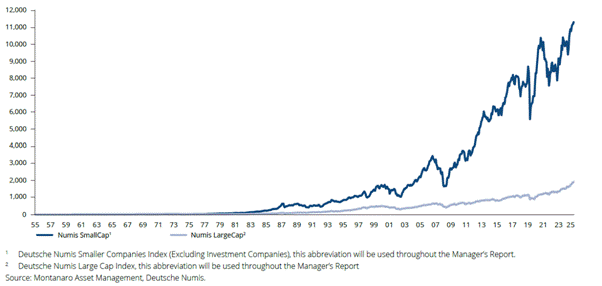
In a nutshell, because you can make more money. Over the last 71 years, on average UK smaller companies have delivered 2.8% p.a. more than larger ones. That may not sound much, but a £1 investment in UK large companies on 1 January 1955 would now be worth £1,900, whereas the same £1 in UK smaller companies would now be worth £11,311 - almost six times more. Now that focuses the mind…
Cumulative Nominal Return of £1 invested on 1 January 1955
(to 31 December 2025)
While some large companies are researched by more than 50 brokers, many smaller companies have little or no coverage. We believe that this makes it easier to identify attractive, undervalued and overlooked investment opportunities.
Who are Montanaro Asset Management?
Montanaro was established in 1991. It took almost three years to raise £10 million which was invested in a limited partnership launched in 1993. MUSCIT was launched in March 1995 shortly after the collapse of Barings Bank. We were a team of just three at the time and raised £25 million, a milestone that feels like only yesterday.
We now have one of the largest and most experienced specialist teams in the UK. Our team of thirty-six includes 11 nationalities and 16 analysts and portfolio managers, which gives us the high level of resources that you need to meet our companies and to complete due diligence in-house. Smaller company research is all about people and kicking the tyres. At 31 March 2026, we were looking after over £2 billion of client assets.
Investment Philosophy
We are unashamedly "Quality Growth" investors with an investment philosophy akin to Warren Buffett's. Investing in UK SmallCap seems so obvious - they can grow faster, so should give higher returns over time; there are plenty to choose from that are "hidden gems" and undervalued; why would you not buy the highest quality, growing companies run by the very best management teams?
We look for high quality companies in markets that are structurally growing. They must be profitable; have good and experienced management; deliver sustainably high returns on capital and free cash flow; enjoy high and ideally growing profit margins reflecting pricing power and a strong market position; and provide goods and services that are in demand and likely to remain so. This makes them more predictable. We like companies that are focused, simple to understand (rather than conglomerates), well-established with a long history so we can see how they have performed over different cycles. Ideally, they should deliver self‑funded organic growth rather than rely on acquisitions and stick firmly to their core areas of expertise. We want to know where they will be in five years' time or longer and what they will look like.
Conversely, we avoid those with stretched balance sheets; poor free cash flow generation; incomprehensible or heavily adjusted accounts riddled with exceptionals; unproven or unreliable management; that face structurally challenged business models with stiff competition; and "special situations" or recovery companies. Our experience has been that few are that "special" and many finally recover (if indeed they do at all) from a much lower share price.
A deep understanding of how a company makes money and the way it is managed are essential. We meet and speak to our investee companies on a regular basis, typically after they announce their semi-annual or annual figures. Site visits are particularly useful. We meet management in situ whenever possible so they can give us more time and we can talk to more people. It is a privilege for us and probably where we can add most value. We always arrive well prepared.
Investment Process
We have a two-stage investment process. Firstly, we identify "good businesses" within our investable universe typically using our proprietary screen that has been developed over decades. We come up with most new ideas ourselves. In the second stage, we try to work out what they are worth and if they will make a "good investment" (the two may not be the same). We produce our own comprehensive financial models.
We complete Quality and ESG checklists to assess the quality of a company. ESG has been integrated within our disciplined investment process for almost three decades - for many years we looked after a mandate for the Church of England that started in 2005. Our analysts present any new idea to our Investment Committee (consisting of senior professionals from within the Team) for approval prior to adding it to our "Approved List".
Only the most attractive companies make it on to the Approved List. It is from these that we build the MUSCIT portfolio. With over 1,000 quoted companies in the UK to choose from, we really are spoiled for choice. Investing in UK SmallCap is never dull.
Management's past track record is examined in detail as we seek to understand their goals and aspirations. In smaller companies, the decisions of management can make or break a company (which is why meeting them is so important). We look closely at board structure; the level of insider ownership; and carefully examine remuneration and corporate governance policies.
Once a company has been added to the portfolio, our analysts conduct ongoing reviews. We will sell a holding if we believe that the company's underlying quality is deteriorating; or if there has been a fundamental change to the investment case, or indeed management. We will get things wrong and make mistakes, but we do try to learn from them. Even after all this time, I learn something every day.
In summary, we invest in well managed, focused, high quality, growing companies that are comprehensible and invest at sensible prices. Valuation matters. We follow our companies closely over many years. We would rather pay more for a higher quality, more predictable company that can be valued with greater certainty. We like to sleep at night.
Lessons from history
We have long argued that clues to future performance lie in the past. Human nature broadly does not change. If we look back at previous periods with similarities to today, it is possible to anticipate what comes next. Nowadays, we drown in information - what we term "noise" - which has become even more pervasive thanks to AI.
At the press of a button, now we can all get information on any topic you can think of. But there is a serious risk that investors end up not seeing the wood for the trees. One of the few benefits of more grey hair than most is having lived through numerous cycles including no less than seven bear markets. Each was different but there were patterns worth noting.
Why invest in equities at all?
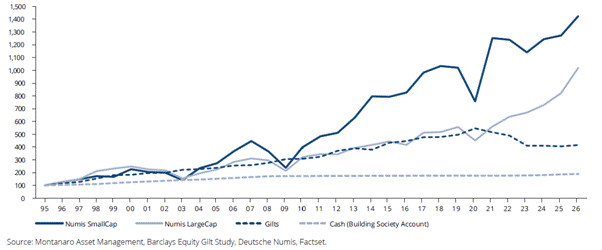
At the risk of teaching your grandmother to suck eggs, the worst thing you can do with your hard-earned money prudently set aside for your retirement is to simply leave it sitting on deposit in the bank. Although there is no risk (unless the bank goes bust - don't forget Barings), by taking virtually no risk, you basically get no return after you take inflation into account. Crudely, as you move up the risk spectrum, you get compensated for the extra risk by ever higher returns (although you face more volatility). Cash is the lowest risk; then bonds/gilts; blue-chip LargeCap; then SmallCap. The following chart shows this very clearly taking the launch date of
MUSCIT as the starting point:
Cumulative Total Returns
(from 31 March 1995 to 31 March 2026)
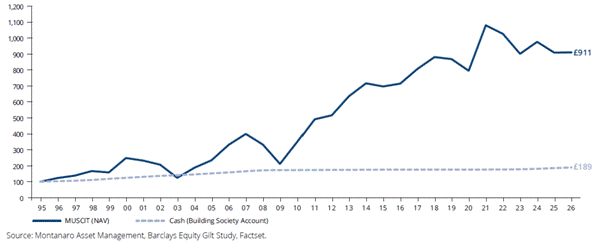
Although UK SmallCap is riskier than LargeCap due to higher volatility and lower liquidity, the next chart simply compares an investment in MUSCIT from launch to simply leaving £100 in cash. Whilst as fund managers we agonise and despair about periods of underperformance (such as we have just seen), it is a salutary reminder that it could have been worse - we could have been in cash:
Cumulative Return of £100 invested at MUSCIT Launch
(from 31 March 1995 to 31 March 2026)
MUSCIT's Investment Objective
A quick reminder: MUSCIT's investment objective is primarily to deliver capital growth by investing in UK SmallCap (listed on the London Stock Exchange or traded on AIM) and to outperform the Deutsche Numis Smaller Companies Index (excluding investment companies) over time.
Our approach remains and always will be to follow a disciplined "Quality Growth" philosophy. MUSCIT also targets a regular income stream via a quarterly dividend of 1.5% of NAV (c. 6% per annum or 6.4% adjusting for the discount).
What did we do last year?
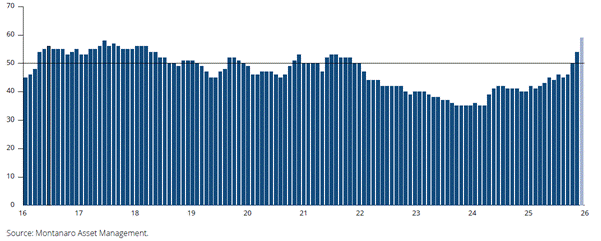
Conscious of a challenging macro-economic environment, we decided to actively reshape the portfolio to lower risk by increasing diversification. The number of holdings increased from 40 to 59 and concentration fell as a result: the top 10 investments have reduced from c.41% a year ago to c.32% of the portfolio now. We have returned the number of holdings back to where it was in the past. The target going forward is to invest in 50 - 60 "great" UK SmallCaps:
We have reduced sector exposure where we felt that cyclicality risk had increased and redeployed capital into a broader opportunity set, remaining firmly within our Quality discipline. We sold Greggs, SThree and Marshalls and lost Alpha Group to a takeover. We exited Polar Capital (given our assessment of how an "AI bubble" reversal could affect technology investors - which has yet to be proven right).
This gave us the opportunity to invest in several exciting new companies traded on AIM which we feel is due a recovery after a few difficult years. We started new positions in Craneware, Restore, FRP Advisory, Renew Holdings, SRT Marine Systems and Filtronic. We also participated in the Beauty Technology Group flotation, which proved a great success. At the time of writing, they have upgraded earnings forecasts no less than four times. Many congratulations to an exceptional and very likeable management team.
1: High-Growth Strategic Themes | 2: Indirect/Enabling Exposure |
a) Electrification/Energy Transition/Grid Upgrade · Volex: critical supplier of power/data cables (EVs, renewables and data centres) · Hill & Smith: infrastructure supporting electrification (grid, transport safety) · Volution Group: energy efficiency & indoor air quality (regulatory tailwind) b) Nuclear · Avingtrans: one of the few quoted UK smaller companies with genuine nuclear supply chain exposure such as Sellafield · Goodwin: highly specialised engineering to nuclear/defence industries c) Defence, Security & Space · Cohort: strong defence electronics and naval systems · Filtronic: RF/microwave tech with applications in space, satellite comms, defence radar · SRT Marine Systems: maritime domain awareness, surveillance systems (border security, "blue economy") | a) Resource Nationalism/Critical Minerals/Energy Security · Ecora Resources: royalty exposure to commodities critical for electrification (copper, etc.) · Capital Limited: mining services · Amaroq Minerals: gold
b) Infrastructure Upgrade/Environment · Renew Holdings: maintenance of critical infrastructure (rail, energy networks) · Restore: data/storage compliance (regulatory-driven demand)
c) Digitalisation/SaaS/Data · Craneware: US healthcare digitisation · Pinewood Technologies: SaaS transformation in auto retail · Elixirr International: advisory into digital/AI transformation |
3: Domestic/Consumer | 4: Financials & Real Estate |
· A.G. Barr: branded beverages like IrnBru(which we owned in the past) · Hollywood Bowl: ten pin bowling roll-out · Angling Direct: niche retail for the fisherman · The Beauty Tech Group: beauty/skin devices (IPO)
| · Rathbones Group: discretionary wealth manager benefiting from structural growth in advised assets · Mortgage Advice Bureau: tech-enabled mortgage broker network gaining market share · FRP Advisory Group: restructuring and advisory specialist · Derwent London: central London office REIT · Savills: global property advisor
|
The portfolio is now less benchmark-sensitive, less volatile, more defensive with a beta¹ of 0.92 versus the benchmark; a tracking error² of 5.5% (it reached a high of 11.4% in September 2022 and a beta of 1.16 in March 2024); retaining a high active share³ of over 83%. The forward-looking portfolio fundamentals look attractive: a 2026 P/E of 13.6x and an expected Earnings Per Share (EPS)⁴ growth of 12.8%; 2026 expected Return on Equity (ROE)⁵ of 20%; and portfolio-level net debt-to-equity ratio⁶ of -3% (i.e. close to net cash overall).
1 Beta is a measure of a portfolio's sensitivity to market movements and is calculated by comparing its historical returns to those of an index. A beta above one indicates higher volatility than the index, a beta below one indicates lower volatility than the index, and a negative beta indicates that the investment tends to move in the opposite direction to the index.
2 Tracking error is a measure of how closely a portfolio follows its benchmark and is calculated as the variability (typically the standard deviation) of the difference between the portfolio's returns and the benchmark's returns over time.
3 Active share is a measure of how much a portfolio's holdings differ from those of its benchmark and is calculated as the percentage of the portfolio that does not overlap with the benchmark's constituent weights. An active share of 0% indicates full replication of the benchmark, while 100% indicates no overlap with the benchmark holdings.
4 Earnings per share (EPS) is a profitability measure calculated by dividing a company's net income (after tax and preferred dividends) by the weighted average number of ordinary shares outstanding during the period. EPS growth is a measure of the rate at which earnings per share increase or decrease over time. It is typically expressed as a percentage change from one period to the next and is used to assess trends in profitability.
5 Return on equity (ROE) is a profitability measure calculated by dividing a company's net income by its shareholders' equity. It indicates how effectively the company uses equity capital to generate returns for shareholders.
6 Net debt‑to‑equity ratio is a leverage measure calculated by dividing a company's net debt (total interest‑bearing debt minus cash and cash equivalents) by its shareholders' equity. It is used to assess a company's balance sheet risk and reliance on debt financing relative to equity capital. A company is described as "net cash" when it has more cash and cash equivalents than interest‑bearing debt.
Performance
In the year ended 31 March 2026, the NAV returned a modest 0.1% in comparison with the benchmark gain of 11.9%. Including AIM, the benchmark increased by 11.0%. Although a positive return is better than nothing, we were disappointed not to deliver the sort of returns we have been used to in the past.
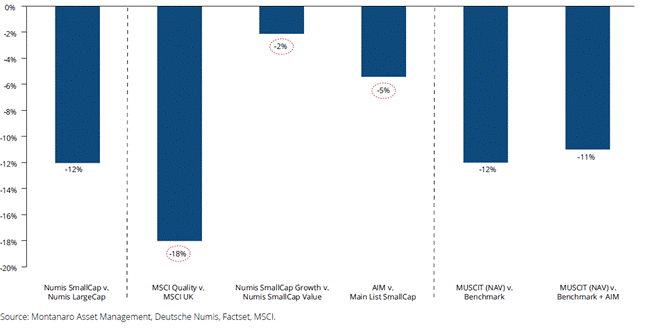
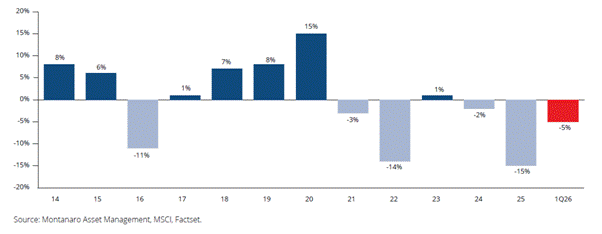
However, style has continued to be a headwind: in the 12 months to 31 March 2026, Growth underperformed Value by -2.1%; Quality lagged the broad UK Stock Market by -17.9%; AIM underperformed UK SmallCaps listed on the Main Market by -5.4% and for the fifth consecutive year. As Quality Growth investors with investments in AIM, it is little wonder that the past year was challenging once again.
(to 31 March 2026) | 1 Year | 3 Years | 5 Years |
Quality v. UK Market | -18% | -28% | -51% |
Small Growth v. Value | -2% | -15% | -33% |
AIM v. Listed SmallCap | -5% | -32% | -50% |
MUSCIT v. Benchmark | -12% | -24% | -29% |
Indices used, from top to bottom: MSCI UK Quality v. MSCI UK; Numis SmallCap Growth1 v. Numis SmallCap Value2; Numis Alt Markets3 v. Numis SmallCap (ex-ICs).
Source: Montanaro Asset Management, Deutsche Numis, Factset.
Three factors impact our ability to outperform:
1) Quality does well;
2) Growth does better than Value; and
3) AIM outperforms.
Last year, each of these factors was negative, making it a truly challenging and unenviable time for Quality Growth SmallCap investors. This "perfect storm" has lasted for four years and is unprecedented by historic standards:
Relative Returns - 12 months to 31 March 2026 (total return)
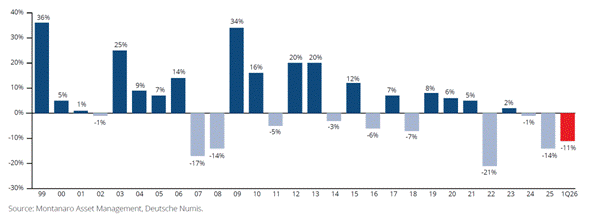
UK SmallCap has faced a tough time since the Ukraine war began in 2021:
UK SmallCap v. UK LargeCap
(Numis SmallCap v. Numis LargeCap, total return)
Quality has suffered as investors bought banks, commodities and energy:
UK Quality v. UK Market
(MSCI UK Quality v. MSCI UK Index, total return)
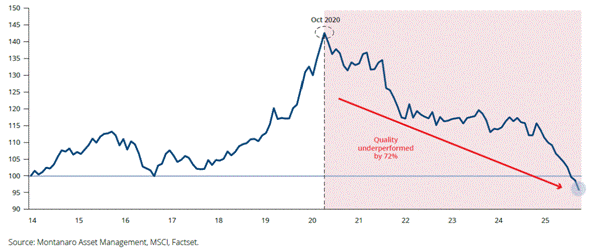
Quality has underperformed by 72% since October 2020:
UK Quality v. UK Market - Relative Performance (rebased)
(MSCI UK Quality v. MSCI UK, total return)
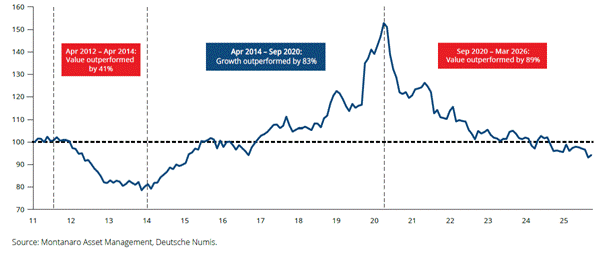
Growth has underperformed Value by a staggering 89% since 2020 and completely reversed the previous 6.5 years of outperformance by Growth:
UK SmallCap Growth v. UK SmallCap Value - Relative Performance (rebased)
(Numis Smaller Companies Growth v. Value Index, total return)
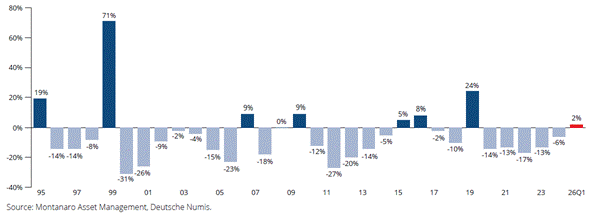
… and AIM has underperformed for the last five consecutive years:
AIM v. Main List SmallCap Returns
(Deutsche Numis Alternative Markets v. Numis SmallCap, total return)
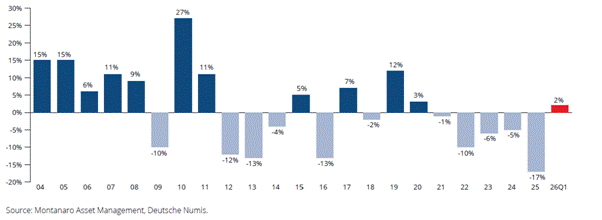
Given the extreme underperformance of Quality, Growth and AIM, it was inevitable that MUSCIT would also underperform, although, encouragingly, the early signs of a recovery are beginning to emerge.
MUSCIT v. Benchmark - NAV (total return)
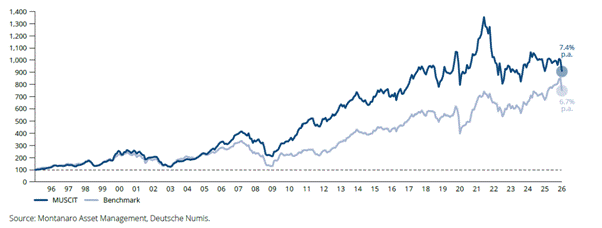
This period needs to be put into perspective. Since its launch in March 1995, MUSCIT has delivered an average annualised NAV return of 7.4% p.a. (including dividends reinvested), outperforming the benchmark by 0.7% p.a.. We have delivered a cumulative NAV total return of 811%, significantly outperforming the benchmark return of 651%.
Despite a tough few years recently which hurt the long-term track record, we have still outperformed since launch after all fees and costs.
Cumulative NAV Total Returns since MUSCIT launch
Best and Worst performers
The largest positive contributors over the year were:
XP Power, a designer and manufacturer of power control solutions for industrial and healthcare applications, performed strongly as demand recovered and margins improved, helped by easing supply chain pressures.
JTC, a provider of fund administration and corporate services, received a takeover offer by private equity group Permira at a c.50% premium.
Alpha Group, a specialist in corporate foreign exchange and alternative banking solutions, saw a takeover approach from US‑based Corpay at an even larger c.55% premium.
So, we received two take-over offers last year.
As ever, the year was not without some disappointments. The largest detractors were:
Hilton Foods, an international food packaging and distribution company, saw margin pressures from higher seafood prices and weaker consumer demand, particularly in more price-sensitive markets.
Bytes Technology, a value-added reseller of software licences and an IT solutions provider, faced a period of softer growth not helped by investor concerns around an internal reorganisation that did not go well.
XPS Pensions, a pensions consulting and administration firm, saw growth expectations moderate. The shares consolidated after a period of strong outperformance in previous years. XPS has been a top contributor in the past. They are a superb management team.
How have our companies fared?
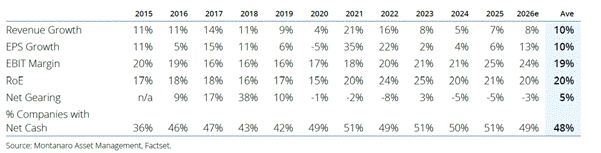
Despite the style challenges shown above, if you look at how our companies have performed, the picture is much rosier. Over the past decade, our companies have delivered an average 10% p.a. growth in earnings:
Outlook for UK SmallCap
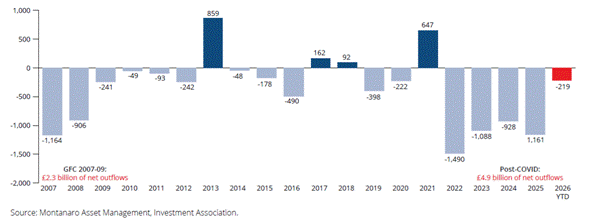
Over the past four years, we have seen constant outflows from UK SmallCap totalling £4.9 billion. We are witnessing a doom cycle: as active managers have been unable to match the performance of the Magnificent Seven and ETFs have ballooned, SmallCap funds and - largely thanks to Saba Capital - investment trusts have been wound up and the portfolios liquidated. Large institutions such as wealth managers and pension funds have exited closed end funds and less liquid asset classes. There have been very few buyers.
Net Flows in UK SmallCap Funds (£ million)
We need to see a return of confidence. This requires an end to the macroeconomic uncertainty such as we have seen due to COVID, the Ukraine and now Iran wars and the associated supply chain disruptions and oil price shocks. A return to normality would bring with it lower inflation and falling interest rates, which would be welcome.
But confidence is fickle. It returns when you least expect it: after the TMT Bear Market of 2000 - 2003, it was all doom and gloom until suddenly, in March 2003, the market went up and carried on doing so. We saw similar doom and gloom after the Global Financial Crisis of 2007 - 2009 (Lehman Brothers went bust in September 2008), and the same thing happened in March 2009. The next bull market started.
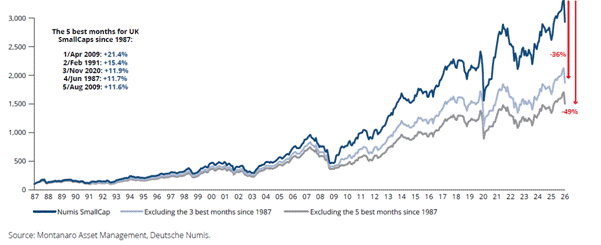
No-one rings a bell at the bottom as we all know. In SmallCap, it pays to be invested before confidence returns. Had you missed the best five months since 1987, your returns would be 50% less!
Numis SmallCap Index (total returns, January 1987 - March 2026)
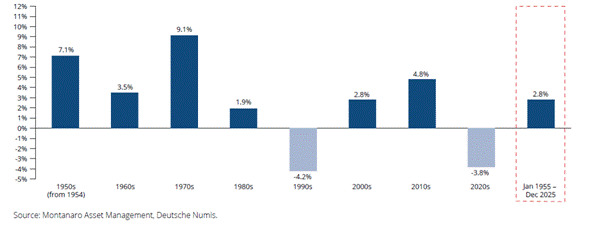
If you look at the performance of UK SmallCap by decade, with only one exception (now two) UK SmallCap was the place to be:
UK - Relative Performance by Decade (annualised)
(Numis SmallCap v. Numis LargeCap, December 1954 - December 2025)
What happened in the 1990s? Montanaro was established in 1991, so this period remains vivid in the memory. It was a decade during which it felt that every other year there was a crisis. In a crisis, investors lose confidence and there is a flight to cash/liquidity. UK SmallCap sees redemptions and fares poorly.
Worst Years of UK SmallCap Underperformance
(Numis SmallCap v. Numis LargeCap indices, total return)
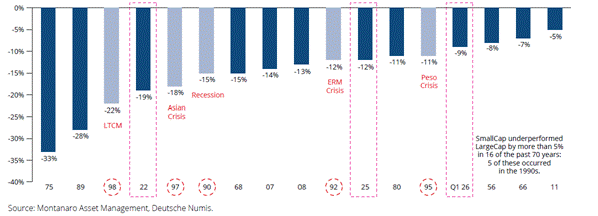
As we have reached the half-way point of this current decade, in three years out of five, there has been a "crisis". Little wonder that it has been a challenging period. It has been eerily similar to the 1990s.
The 1990s marked the longest bear market in UK smaller companies that we have ever seen. The past few years have witnessed the second longest bear market. Please note that after each pink period (bear market), the next bull market for UK SmallCap begins.
UK SmallCap v. UK LargeCap (rebased in 1955)
(Numis SmallCap v. Numis LargeCap, total returns)
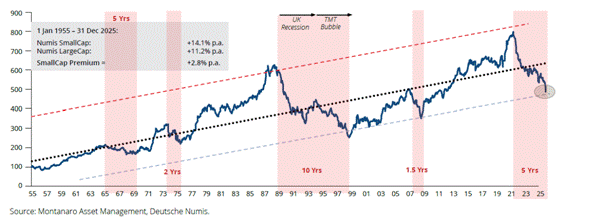
Please also note that, since 1955, you have been better off investing in SmallCap rather than LargeCap 58% of the time.
UK SmallCap is trading on less than ten times earnings and well below its long-term average price to earnings ratio (P/E)
UK SmallCap - 12 month forward P/E
(Numis SmallCap)
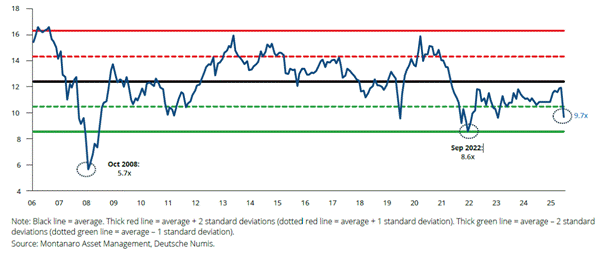
... and near a 20-year low P/E premium v. UK LargeCap
UK SmallCap v. UK LargeCap - 12 month forward P/E
(Numis SmallCap v MSCI UK LargeCap)
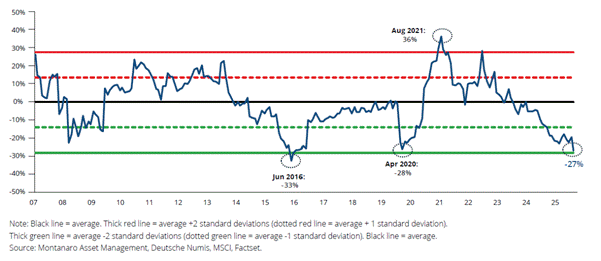
UK SmallCap also looks attractive on a Shiller P/E¹
UK SmallCap - 10-year Shiller P/E
(Numis SmallCap)
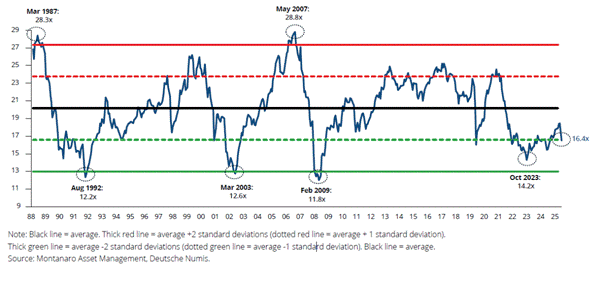
¹The Shiller P/E is a long‑term valuation measure calculated by dividing the current price of a stock or equity index by the ten-year average of its inflation‑adjusted earnings. This produces a more stable long term assessment of valuation because earnings are smoothed across business cycles.
Outlook for MUSCIT
Consensus expectations point to an acceleration in earnings growth through 2026, returning to double-digit rates after several subdued years. Importantly, we continue to see balance-sheet strength across the portfolio (half of our holdings hold net cash).
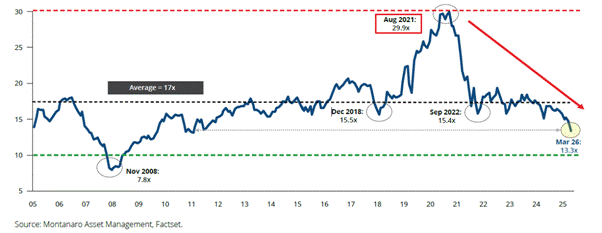
MUSCIT's P/E valuation has more than halved since 2021, back to levels last seen fifteen years ago:
MUSCIT - 12 month forward P/E
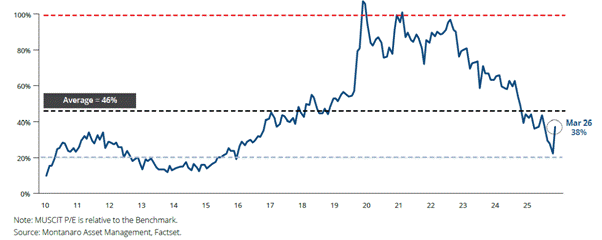
The premium has fallen from over 100% in 2020 to below the long-term average:
MUSCIT v. Benchmark - 12 month forward P/E Premium
The outlook for MUSCIT's earnings growth is now the strongest in several years (and better than for larger companies). The key determinant of returns comes down to growth of earnings, so this is encouraging. Over the past two decades, MUSCIT has delivered earnings growth more than double the market:
EPS Growth (Calendar Year)
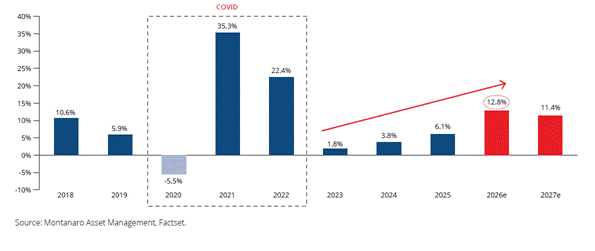
After a subdued few years, we are now expecting double digit earnings growth in 2026 and also 2027:
MUSCIT - EPS Growth (Actual, Consensus for 2026 & 2027)
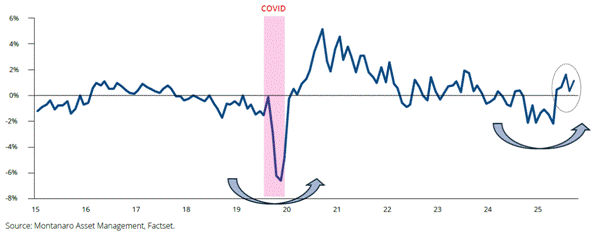
Earnings revisions have been positive this year:
MUSCIT - EPS Revisions (last three months)
Conclusions
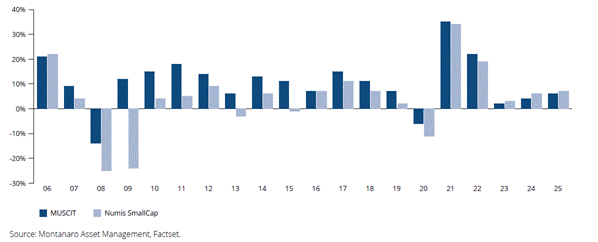
After a challenging few years, it is easy to forget that MUSCIT has enjoyed some great times as well. The following chart shows absolute NAV returns since we launched MUSCIT in 1995 (please look at the blue bars):
MUSCIT - Financial Year NAV Returns (total return)
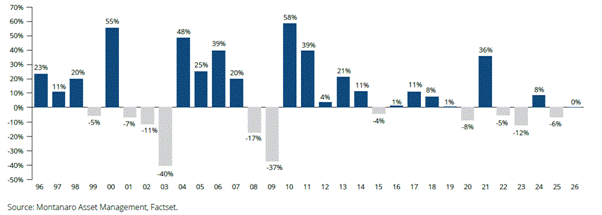
Good times often follow bad; the light is darkest before the dawn; "Be fearful when others are greedy, and greedy when others are fearful" (Warren Buffett); "Buy when there's blood in the streets…Buy on the sound of cannons" (Rothschild); there is light at the end of the tunnel…choose whichever phrase you like…they all apply.
Over the past 45 years, I have learned that all markets mean revert; all cycles come to an end and eventually turn. Surely, that time cannot be far away. Good times will return - history teaches us that they always do.
We will continue to deliver the Trust's quarterly dividend to shareholders amounting currently to over 6% p.a.. As investors ourselves, we are all being paid to wait for the return of the capital returns we have enjoyed in the past.
Continuation Vote
The last time there was a continuation vote was in 2021, when 99.9% of shareholders voted in favour of MUSCIT continuing. This marked the end of a strong period for MUSCIT and Quality Growth investors.
According to Morningstar, as of 31 May 2026, the Company was in the top 4% best performing UK smaller company funds out of a total of more than 50 funds and investment trusts.
MUSCIT Peer Group - Performance Table (ranked by five year performance to 31 March 2026)
1m | 3m | 6m | 1y | 3y | 5y | |
Aberforth Smaller Cos | -11.6% | -3.7% | -2.9% | 13.3% | 27.1% | 23.5% |
JPMorgan UK Small Cap Growth & Income | -12.3% | -6.4% | -6.6% | 7.6% | 22.2% | 2.8% |
BlackRock Throgmorton Trust | -12.6% | -6.1% | -5.5% | 6.7% | 9.7% | -13.0% |
BlackRock Smaller Cos | -11.0% | -5.6% | -5.8% | 3.7% | 2.1% | -14.4% |
Aberdeen UK Smaller Companies Growth | -12.7% | -9.0% | -11.2% | -0.2% | 7.9% | -15.0% |
Montanaro UK Smaller Companies Investment Trust | -9.0% | -5.1% | -7.5% | 0.1% | 1.0% | -15.7% |
Henderson Smaller Companies | -13.4% | -7.7% | -7.8% | 6.1% | 4.3% | -16.7% |
Artemis UK Future Leaders | -12.8% | -12.5% | -13.6% | -5.0% | -15.6% | -28.4% |
Numis SmallCap | -13.2% | -6.9% | -4.9% | 11.9% | 24.8% | 13.7% |
Source: Montanaro Asset Management, Deutsche Numis.
Over the past five years, just one single UK SmallCap trust within our core peer group has outperformed the Benchmark and delivered a positive return. This shows what a remarkable period we have just seen.
At the launch of MUSCIT in March 1995, there were 35 UK SmallCap investment trusts. Today only a handful remain. It would be a tragedy if investors are left with ever less choice. Investment trusts are an ideal vehicle for investing in UK, quoted smaller companies for a number of reasons:
1. Investors are more insulated from inflows and outflows: you don't have to sell due to investors panicking out at the bottom of the market - which is especially important when investing in companies traded on AIM where liquidity can be low.
2. It is possible to borrow and increase exposure to UK SmallCap when valuations are particularly enticing (as now). Gearing can increase returns in rising markets.
3. Higher returns: the AIC has plenty of data showing that, where the same strategy is held in a closed or open-ended fund, invariably the closed structure has done better.
We have "skin in the game" and have put our money where our mouth is. Montanaro is the largest institutional investor in MUSCIT and it is also my largest personal investment.
We would love to manage MUSCIT for a further five years. We have just hired three more analysts to the team at a time when many are closing down their SmallCap funds. Our team is stronger than ever - the largest in Europe - and we have learned valuable lessons from the past few years. We have high hopes of the recent additions to the portfolio. There may well be another Dechra or Games Workshop hidden there, destined to make it to the FTSE-100 in time. MUSCIT is in good shape with a bright future.
If you have any questions, please do get in touch (email below). For more information, please refer to: https://montanaro.co.uk/trust/muscit
We will do our best not to let you down. The Board, the whole Montanaro team and I very much hope that you will support the resolution at this year's Annual General Meeting, which would remove the requirement for the Company to seek shareholder approval for a wind-up resolution at the 2027 Annual General Meeting and allow the Company to continue pursuing its long-term investment objectives.
CHARLES MONTANARO
enquiries@montanaro.co.uk
25 June 2026
Top 10 Holdings
as at 31 March 2026
1. IntegraFin - IntegraFin owns Transact, one of the UK's leading independent investment platforms for financial advisers. Its sticky client assets, recurring revenues and strong adviser relationships support long-term growth as wealth management assets continue to shift onto platforms. The business benefits from structural growth in UK savings and pensions markets alongside increasing regulatory complexity.
2. discvoerIE - A global electronics group designing customised components for industrial applications. Its high-margin, design-led model and exposure to structural growth markets such as renewables and automation make it a compelling long-term compounder.
3. Bloomsbury - Bloomsburyis a leading independent publishing house with strong positions in academic publishing and consumer fiction. Its increasingly digital academic offering delivers high recurring revenues and attractive margins, while bestselling authors including J.K. Rowling and Sarah J. Maas support resilient cash generation.
4. Cranswick - Cranswick is a leading UK food producer supplying premium meat and convenience food products to major supermarkets. Long-standing customer relationships, operational excellence and investment in automation support strong market positions and consistent growth. The business also benefits from increasing demand for higher quality and value-added food products.
5. XPS Pensions - A leader in pension consultancy and administration, XPS is well positioned to grow as regulation drives demand for independent, expert advice. Its scalable model and market share gains support long-term, structural growth. XPS won the John Lewis Pension Fund last year with 165,000 members, the largest in the company's history.
6. MP Evans - MP Evans is a sustainable Indonesian palm oil producer focused on high‑quality crude palm oil and efficient plantation management. Strong yields, disciplined capital allocation and rising global demand for vegetable oils underpin attractive long-term growth. The company's emphasis on sustainability and certified production supports relationships with international customers.
7. Luceo - Luceco manufactures LED lighting, wiring accessories and portable power products serving trade and consumer markets. Exposure to energy efficiency trends and electrification supports structural growth, while strong brands and distribution relationships underpin resilient market positions. Its focus on innovation and operational efficiency has supported consistent profitability and cash generation.
8. XP Power - XP Power designs and manufactures power control solutions for industrial technology, healthcare and semiconductor equipment markets. Its highly engineered products serve mission-critical applications where reliability and long product cycles create high barriers to entry. Growing demand for automation, advanced healthcare equipment and semiconductor manufacturing supports long-term structural growth.
9. Hilton Foods - A global food packaging business partnering with leading supermarkets such as Tesco, Woolworths (Australia) and the Co-op. Innovation in sustainable packaging and plant-based products, plus geographic expansion such as in Saudi Arabia, support strong growth. Walmart have just announced a $6.5 billion landmark investment in Canada where they will be working with Hilton Foods.
10. Big Yellow - Big Yellow is the UK's leading self-storage provider with over 100 stores nationwide and a focus on London and the South East. Demand is driven by decluttering, moving, home improvements, student storage, travel, business needs and life events ("death, divorce and downsizing"). Since listing in 2000, it has achieved consistent earnings and dividend growth with annualised total shareholder returns of 13.6%.
Twenty Largest Holdings
as at 31 March 2026
Holding |
Sector |
Value£'000 |
Market cap £m | % of portfolio 31 March 2026 | % of portfolio 31 March 2025 |
Integrafin | Investment Banking and Brokerage Services | 4,590 | 1,009 | 3.8 | 2.4 |
discoverIE | Electronic and Electrical Equipment | 4,573 | 513 | 3.8 | 5.2 |
Bloomsbury | Media | 4,504 | 459 | 3.8 | 2.8 |
Cranswick | Food Producers | 3,923 | 2,819 | 3.3 | 3.1 |
XPS Pensions | Investment Banking and Brokerage Services | 3,625 | 601 | 3.0 | 4.8 |
MP Evans | Food Producers | 3,464 | 793 | 2.9 | 3.2 |
Luceco | Electronic and Electrical Equipment | 3,460 | 278 | 2.9 | 1.7 |
XP Power | Electronic and Electrical Equipment | 3,377 | 291 | 2.8 | 2.0 |
Hilton Foods | Food Producers | 3,322 | 458 | 2.8 | 4.4 |
Big Yellow | Real Estate Investment Trusts | 3,146 | 1,658 | 2.6 | 4.7 |
Games Workshop | Leisure Goods | 3,098 | 5,829 | 2.6 | 2.7 |
The Beauty Tech Group | Personal Care, Drug and Grocery Stores | 3,000 | 266 | 2.5 | - |
Clarkson | Industrial Transportation | 2,997 | 1,415 | 2.5 | 1.9 |
Tristel | Health Care Providers | 2,975 | 166 | 2.5 | 2.1 |
Hill and Smith | Industrial Metals and Mining | 2,947 | 1,694 | 2.5 | - |
Porvair | Electronic and Electrical Equipment | 2,740 | 330 | 2.3 | 3.7 |
Cohort | Aerospace and Defense | 2,727 | 567 | 2.3 | - |
Londonmetric Property | Real Estate Investment Trusts | 2,723 | 1,984 | 2.3 | 2.3 |
Volution Group | Construction and Materials | 2,565 | 1,127 | 2.1 | - |
Watches of Switzerland | Personal Goods | 2,445 | 1,065 | 2.0 | 2.4 |
Twenty Largest Holdings | 66,201 | 55.3 |
All investments are in ordinary shares.
As at 31 March 2026, the Company did not hold any equity interests in excess of 3% of any investee company's share capital.
FURTHER INFORMATION
Montanaro UK Smaller Companies Investment Trust PLC's annual report and accounts for the year ended 31 March 2026 (which includes the notice of meeting for the Company's AGM) will be available today on https://montanaro.co.uk/trust/montanaro-uk-smaller-companies-investment-trust/
It has also been submitted in full unedited text to the Financial Conduct Authority's National Storage Mechanism and is available for inspection at data.fca.org.uk/#/nsm/nationalstoragemechanism in accordance with DTR 6.3.5(1A) of the Financial Conduct Authority's Disclosure Guidance and Transparency Rules.
 Follow the stocks