
 Sign In





 Last checked at
18 Aug 2025 07:00
18 August 2025
Kavango Resources
("Kavango" or "the Company")
BOTS - Karakubis Technical Project Update
Kavango Resources plc (LSE:KAV), the Southern Africa focussed metals exploration company, is pleased to provide an update on its recently completed ground geophysical programme at the Karakubis Copper Project ("Karakubis") in Botswana's Kalahari Copper Belt ("KCB").
In collaboration with First Quantum Minerals (TSX:FM) ("First Quantum"), Kavango gathered additional Controlled-Source Audio-frequency Magnetotelluric ("CSAMT") and Induced Polarization ("IP") data along a section line located over First Quantum's deep (1,266.40m) mineral systems exploration hole.
This has provided Kavango with access to important drill core, across the key target horizon for copper-silver mineralisation in the KCB. Such physical data acts as a crucial control for interpretation of geophysical survey data to identify higher-confidence drill targets.
Kavango's team has now spent six months improving its interpretation of geophysical survey data taken over recent years at Karakubis to develop a target model for discovery of potential Tier 1 copper-silver mineralisation.
The Company is encouraged by the results of this and is currently preparing final targets for a follow-up drill programme later this year.
Ben Turney, Chief Executive Officer of Kavango Resources, commented:
"We are extremely pleased with how exploration of our Karakubis Copper Project, part of our 6,200km2 KCB mineral rights package, is progressing. We are applying sophisticated targeting techniques that are delivering promising results, as this recently completed comprehensive and integrated geophysical programme show. The geophysics is allowing us to develop further our understanding of previous drill results. New interpretations are developing answers to a variety of key questions on the structural architecture and potential for the southern margin of the KCB to host large Tier 1 deposits. Results from this important phase of work will be used to refine our geophysics driven targeting strategy.
Karakubis is an extremely large project that appears increasingly prospective for large-scale copper deposits. These technical steps are important for our team's understanding of the stratigraphy of the Karakubis area and are critical stage gates on our path towards commercial discovery."
Integrated Geophysical Exploration Programme
The integrated geophysical programme gathered both CSAMT and IP data. This data has been processed, inverted, and modelled by Kavango. Combined with previous drill results this data has provided insightful perspectives and new interpretations that may provide answers to a variety of key questions on the structural architecture and resulting prospective potential for the Kara Antiform to host large Tier 1 deposits. All interpretations herein are by Kavango Resources.
In 2024 First Quantum Minerals (TSX:FM) drilled a 1,266.40m diamond mineral systems exploration hole in ground immediately along strike and adjacent to Kavango's Karakubis Project on the Kara Antiform. This diamond hole targeted interpreted anticlinal trap-sites and the underlying D'Kar Formation ("DKF") and Ngwako Pan Formations ("NPF") contact zone. This is known to host the majority of mineralisation and associated deposits on the KCB including MMG Zone 5 Mine and Sandfire's Motheo Mine along strike.
Kavango performed additional CSAMT and IP, at its expense, across the F drill line, to be able to apply direct drill hole control on the geophysical interpretations. Each geophysical traverse was designed to:
· Deliver key insights into the deeper KCB basin architecture, including the geophysical characteristics of the underlying lithologies and provide crucial information on the depth to the underlying DKF/NPF contact position.
· Identify structural conduits that may act as fluid migration pathways, and structural trap sites, in order to assess the potential for Tier 1 copper deposit formation along the Kara Antiform.
Identify structures such as anticlinal fold hinge zones and any associated potential trap sites, while examining the key factors influencing copper-silver deposition, including the interplay between alteration, pathfinder element distribution, sulphides, and mineralisation observed in previous drilling.
Regional Geological Setting and Mineralisation
Mineralisation on the KCB is sediment-hosted and structurally controlled, with copper-silver mineralisation principally occurring at the redox contact between the basal reduced marine sedimentary sequences of the D'Kar Formation and the oxidised clastic marine units of the Ngwako Pan Formation.
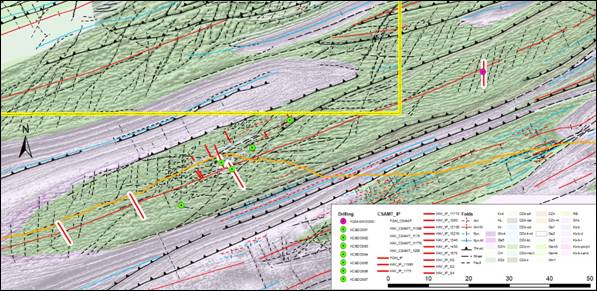
The Kara Antiform shown in Figure 1 consisting of D'Kar Formation lithologies surrounded by Mamuno Formation comprises a series of tight, asymmetric folds locally bordered by shears, which possibly served as crucial fluid pathways for the movement of copper-rich fluids during basin formation and inversion. These preserved, dome like, anticlinal fold hinge zones appear to form the ideal trap sites to host the copper-silver mineralisation that regionally host large deposits like Sandfire's Motheo Mine, A4 and A1 deposits.
Geophysical Methods
The ground geophysical surveys were designed for deep investigation and resolution of the DKF and NPF sediments. Induced Polarization ("IP") surveys utilised Stacked Schlumberger Soundings which can achieve good lateral and vertical resolution down to 1200m depth with multiple current injections. Both Resistivity and Chargeability were measured and inversions of these data produced IP sections that can be interpreted for understanding the geology. It is Kavango's approach that the Resistivity is responding to the contributions of lithology, structure and alteration. The Chargeability is thought to be responding to changes in low grade magnetite or hematite content. Both of these parameters are interpreted here to be showing the DKF/ NPF contact.
The CSAMT surveys were tuned to measure Resistivity to depths of about 3000m. Since the method is different from IP, with a different way of energizing the ground, this method is considered by Kavango to be complimentary to the IP surveys. Bostick Transforms were used to solve the inverse problem for the geological conditions in the KCB. Various filters onboard the Geometrics receiver were used to remove measurement statics and to emphasize specific wavelengths for elucidating the geology. Kavango Resources interpret the resultant Resistivity sections to show the DKF / NPF sedimentary units and the probable DKF/ NPF contact.
Further tuning of these geophysical surveys is planned by Kavango. The careful procedures for electrical contact used by 3D Earth Exploration (Pty) Ltd facilitates pushing the depth of meaningful IP data deeper. Kavango hopes to push the IP to 1500m depth. The adjustment of parameter for the CSAMT surveys will, in contrast, be tuned to detect shallower and shorter wavelength parasitic folds by using tighter dipoles.
Geophysical Interpretation
Kavango interpret the processed geophysical data appears to show a dominant district scale antiform hosting a series of parasitic anticlines and synclines.
The CSAMT sections shown (Figures 2 & 3) following are all images from the 50m dipole 3D Bostick resistivity transform using a 0.2 spatial filter, which provides the clearest representation of the interpreted geology. The bounding boxes used on the sequence of sections are to relate the relative scale of the CSAMT data area with that of the Insight section IP data area. The CSAMT section lines averaged 7km with an average depth of investigation of 3km while the Insight IP was collected over the same lines but with a depth extent averaging >1,000m.
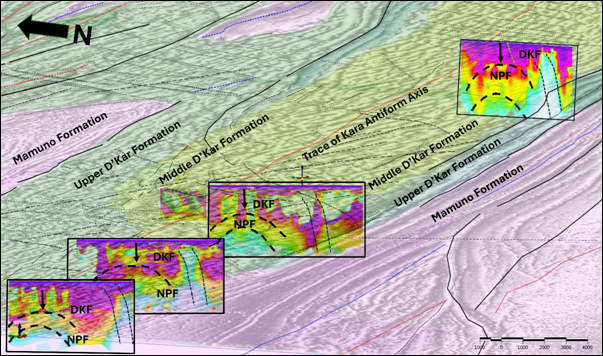
The CSAMT sections have been interpreted to show the antiformal axis, which may represent more conductive reduced marine units of the DKF, folded around a core of resistive core, possibly related to oxidised partially hematised and altered clastic arkose of the NPF. The structural measurements in the First Quantum drill hole suggest it was collared on the northwest limb of a parasitic fold within the larger Kara Antiformal dome.
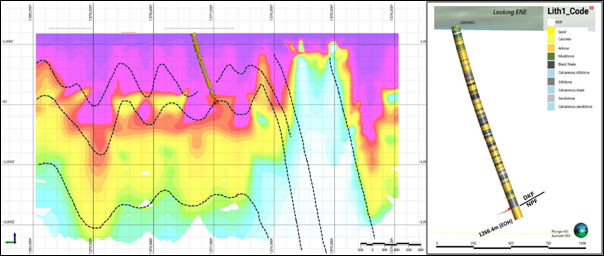
The corresponding Insight IP section resistivity and chargeability sections (Figures 4 & 5) also appear to support structural measurements from the First Quantum drill hole suggest it was collared on the northwest limb of a parasitic fold within the larger Kara Antiformal dome.
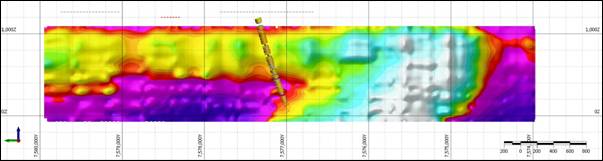
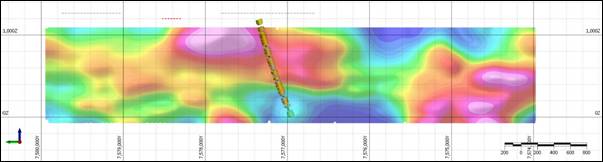
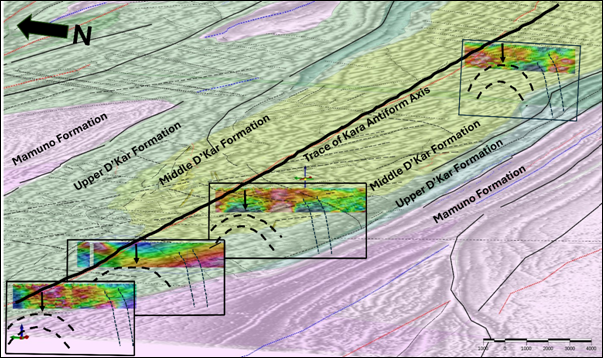
The Insight IP 50m sections and processed inversions (Figures 6 & 7) also appear to demonstrate how the Kara Antiform comprises a series of anticlines and synclines composed of interbedded sequences of reduced marine units of the DKF folded around a core consisting of oxidised partially hematised and altered clastic arkose of the NPF. 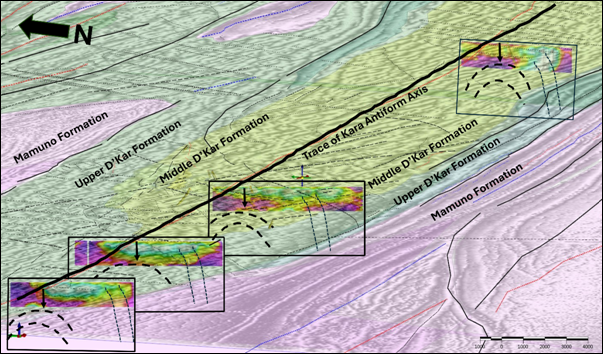
Regional Geological Setting and Mineralisation Targeting
A schematic representation of a model based on preservation of anticlinal fold hinges and domes with associated parasitic folding on the limbs and bound by district scale shears is shown in Figure 8. Kavango's current exploration efforts are focused on advancing and testing these buried anticline hinge zone targets, which are considered the most promising locations for the formation of Tier 1 deposits along the Kara Antiform.
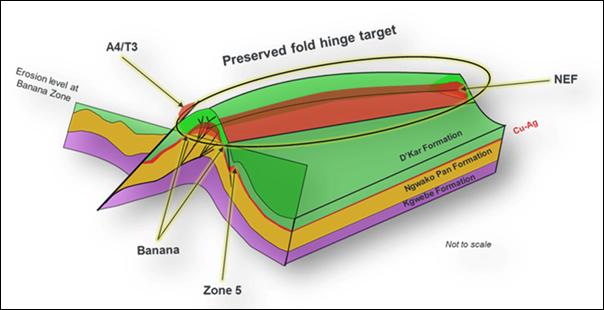
Kavango will systematically compile all the data from its drilling and geophysical programmes and use the data to vector towards a possible discovery.
For further information please contact:
Kavango Resources plc
Ben Turney
+46 7697 406 06
Shard Capital (Broker)
Damon Heath
+44 (0) 207 186 9952
BlytheRay (Financial PR)
Tim Blythe/Megan Ray/Said Izagaren
kavango@blytheray.com
Tel: +44 207 138 3204
Kavango Competent Person Statement
The technical information contained in this announcement pertaining to geology and exploration have been compiled by Mr David Catterall, a Competent Person and a member of a Recognised Professional Organisations (ROPO). David Catterall has sufficient experience that is relevant to the style of mineralisation and type of deposit under consideration and to the activity being undertaken to qualify as a Competent Person as defined in the 2012 Edition of the Australasian Code for Reporting of Exploration Results, Mineral Resources and Ore Reserves (JORC 2012). David is the principal geologist at Tulia Blueclay Limited and a consultant to Kavango Resources. David Catterall is a member of the South African Council for Natural Scientific Professions, a recognised professional organisation.
The technical information contained in this announcement pertaining to geophysics have been read and approved by Mr. Jeremy S. Brett, M.Sc., P.Geo., Senior Geophysical Consultant, Jeremy S. Brett International Consulting Ltd. in Toronto, Canada. Mr. Brett is a member of the Professional Geoscientists of Ontario, the Prospectors and Developers Association of Canada, the Canadian Exploration Geophysical Society, and the Society of Economic Geologists. Mr. Brett has sufficient experience that is relevant to geophysics applied the styles of mineralisation and types of deposits under consideration to act as a Qualified Person as defined under the Canadian National Instrument 43-101, Standards of Disclosure for Mineral Projects.
 Follow the stocks


